UK Mobile Networks: Which Network Every Provider Uses

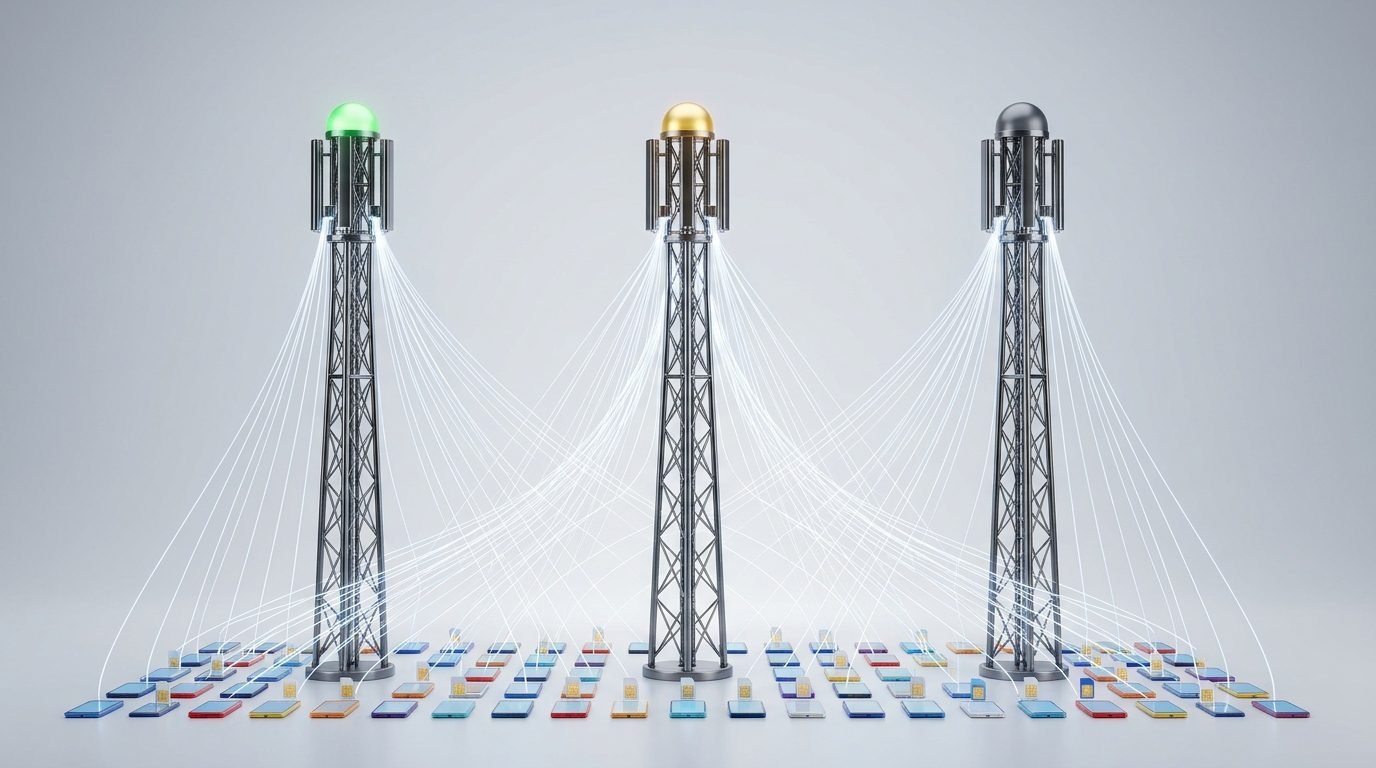
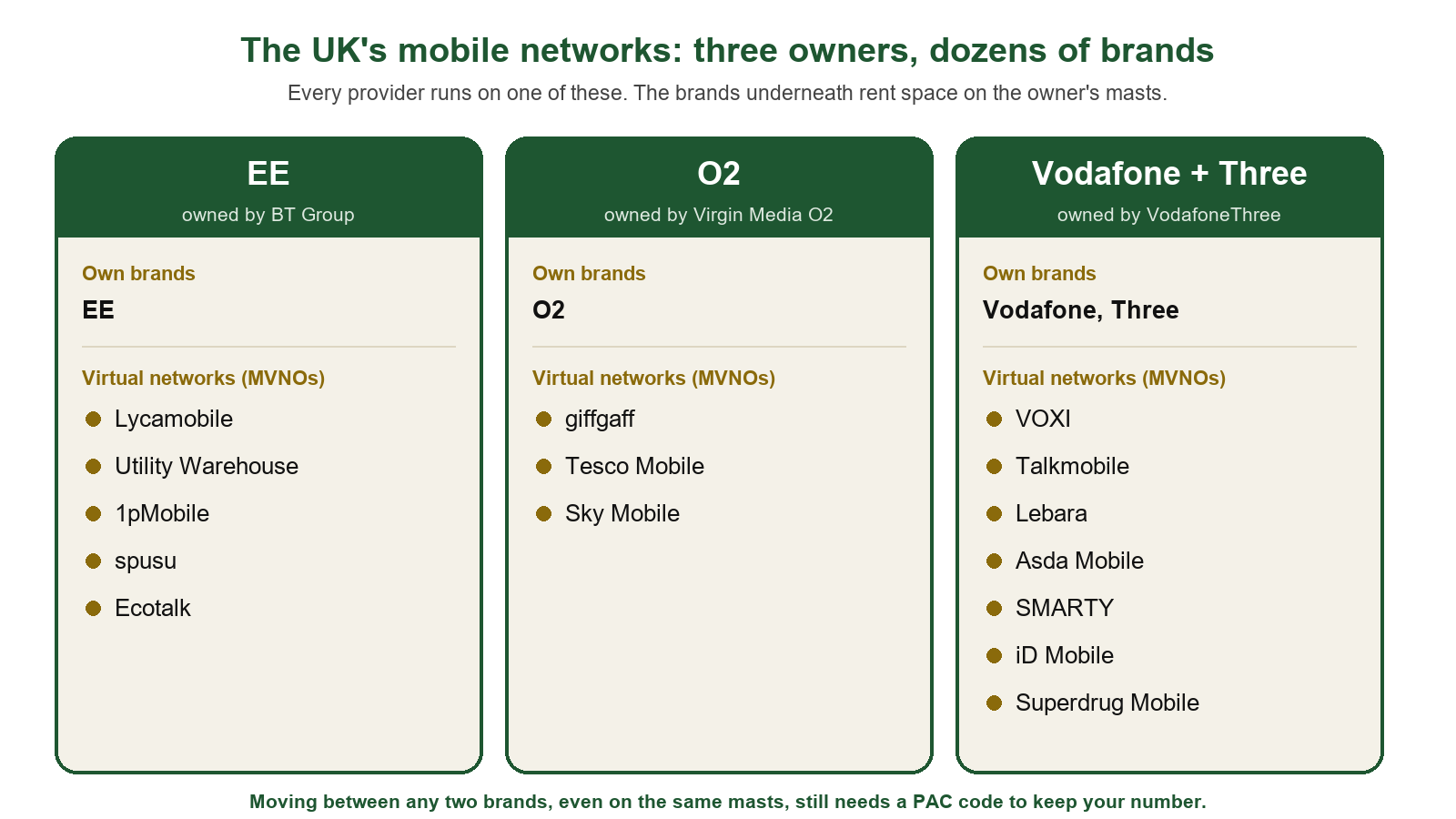
The UK has three mobile network owners: EE (owned by BT), O2 (owned by Virgin Media O2) and VodafoneThree, formed when Vodafone and Three merged in 2025. Every other provider you see, from giffgaff and Tesco Mobile to VOXI, SMARTY and Lycamobile, is a mobile virtual network operator (MVNO): it rents capacity on one of those three and puts its own name on the SIM. So when you choose a provider, you are really choosing one of three sets of masts.
That matters for coverage, because a cheap provider gives you broadly the same signal as its host network. It also matters when you switch: moving between two brands on the same masts still means a full switch with a PAC code. Below is which of the UK mobile networks every main provider uses, what changed with the merger, and how to check before you sign up.
In short: O2 masts carry giffgaff, Tesco Mobile and Sky Mobile. Vodafone and Three masts carry VOXI, Talkmobile, Lebara, Asda Mobile, SMARTY and iD Mobile. EE masts carry Lycamobile, Utility Warehouse, 1pMobile and spusu. Check signal at your address with Ofcom’s free map before you switch.
Which network does each provider use?
| Network (masts) | Owned by | Providers that run on it |
|---|---|---|
| EE | BT Group | EE, Lycamobile (since 2023; previously O2), Utility Warehouse, 1pMobile, spusu, Ecotalk |
| O2 | Virgin Media O2 | O2, giffgaff, Tesco Mobile, Sky Mobile |
| Vodafone | VodafoneThree | Vodafone, VOXI, Talkmobile, Lebara, Asda Mobile (since 2021; previously EE) |
| Three | VodafoneThree | Three, SMARTY, iD Mobile, Superdrug Mobile |
Some of these “independent” names are owned by the networks themselves: giffgaff by O2’s parent company, VOXI by Vodafone, SMARTY by Three, and Talkmobile is a Vodafone brand. The rest are separate companies with wholesale deals, and those deals can change. Lycamobile moved its customers from O2 to EE in June 2023, and Asda Mobile went from EE to Vodafone in 2021. Both changes needed customers to accept a new network, and in Asda’s case a new SIM.
MNO or MVNO: what is the difference?
A mobile network operator (MNO) owns the masts, the spectrum licences from Ofcom and the core network that routes your calls. An MVNO owns none of that. It buys capacity in bulk from an operator and handles the parts you see: the price, the app, the SIM, customer service and billing. You can spot the link in small details: SMARTY and iD Mobile give the same voicemail number as Three.
For you, three things usually follow:
- Signal is broadly the same as the host. A giffgaff SIM picks up the same O2 masts as an O2 SIM. If O2 is weak at your house, giffgaff will be too.
- Prices are usually lower. MVNOs compete on price and short contracts, often 30-day SIM-only plans with no annual price rise.
- Features can lag. An MVNO does not always get everything its host offers on day one. When Lycamobile moved to EE in 2023, early users reported no Wi-Fi calling and no 4G calling (VoLTE). Before you switch, check the provider’s own page for 5G, eSIM, roaming and calling features rather than assuming you get what the host network advertises.
What the Vodafone and Three merger changed
Vodafone and Three combined their UK businesses as VodafoneThree in mid-2025, making it the largest of the mobile networks in the UK by customers. Vodafone then bought out its partner CK Hutchison’s 49% share for £4.3 billion in 2026, so it now owns the whole business. Vodafone and Three still sell under separate names, and so do the brands that run on them.
The practical change is coverage. Since June 2025, Vodafone and Three customers, including those on SMARTY, VOXI and Talkmobile, have started to connect automatically to whichever of the two networks has the stronger signal. There is nothing to switch on and no extra charge. It is being rolled out mast by mast, though, and full integration is planned to take several years, so the benefit in your area depends on whether local sites have been upgraded.
One thing the merger did not change: Vodafone and Three are still separate providers for switching. Moving from Three to Vodafone, or from SMARTY to VOXI, needs a PAC code if you want to keep your number.
How to check which network is best where you live
- Use Ofcom’s coverage map. Ofcom’s Map Your Mobile tool at ofcom.org.uk/mobile shows, for your postcode, which networks are available and how they perform, combining real-world measurements with the operators’ own predictions. It covers the network owners, and every MVNO inherits its host’s result.
- Look up the provider’s host in the table above, then read the result for that network, not the brand.
- Test before you commit. Most MVNOs sell 30-day plans or send free SIMs. Try one at home, at work and on your commute before porting your number across.
Remember that the check is only a prediction. Ofcom itself says what you experience may differ, particularly indoors.
Can you tell someone’s network from their number?
Not reliably. Ofcom originally gave each network its own blocks of 07 numbers, but anyone can take their number to another provider, and millions have. A number that started life on O2 might now sit on EE or Lebara. The UK mobile number prefix tells you where the number was first issued, not where it is now.
Common questions
How many mobile networks are there in the UK?
Three companies own the networks: EE, Virgin Media O2 and VodafoneThree. Because Vodafone and Three are still sold as separate brands, you will often see “the four networks” in older guides. On top of those sit dozens of other mobile network providers that rent space on them.
Is an MVNO worse than a main network?
Not for signal, which comes from the same masts. Where they differ is service: fewer or no shops, app or chat support only, and occasionally slower access to features like Wi-Fi calling or 5G. If you rarely need help, the lower price usually wins.
Do I need a PAC to move between two providers on the same network?
Yes. giffgaff to Tesco Mobile, or VOXI to Vodafone, is still a change of provider, so your number only moves with a PAC. The process is the same text to 65075 as any other switch; the guides for giffgaff, Tesco Mobile and the smaller networks cover the details.
Can a provider change its network without me switching?
Yes, a provider can move its wholesale deal, as Lycamobile and Asda Mobile have. You keep your number and account; the provider moves you, sometimes with a new SIM. If your signal changes suddenly, it is worth checking whether your provider has switched hosts.
The short version
Three companies own the UK’s masts: EE, Virgin Media O2 and VodafoneThree. Every other brand rents space on one of them, so pick the network that is strong where you live, then the cheapest brand on it that has the features you need. Keep your number with a PAC either way.
Sources
- Vodafone — Vodafone takes full ownership of VodafoneThree, on the £4.3 billion buyout.
- Vodafone — Automatic signal improvement for millions, on customers using both networks.
- SMARTY — What does Three’s merger with Vodafone mean for SMARTY?, on the area-by-area rollout.
- O2 — Tesco Mobile joint venture renewed, on the 50:50 ownership.
- ISPreview — Lyca Mobile users swap from O2 to EE (June 2023).
- Which? — Asda Mobile switches to the Vodafone network (2021).
- Ofcom — mobile checker, signal by postcode.
- Wikipedia — List of virtual network operators in the United Kingdom, cross-checked for host networks of the smaller brands.
Last reviewed 9 November 2026. Wholesale deals change; this list is re-checked when they do.